My father, in a photo of the 38th Engineers on Ascension Island. I have a lot of photos of Ascension, but I had never seen this one. 2nd Lt. William Ashley Chapman is in the back row, sixth from right.
A Colorado man whose father served with mine on Ascension Island during World War II, found a blog I keep about the men who built Wideawake Field. Michael Murray sent me the above photo, which made me ponder the importance of these photos of our loved ones, especially those who we have lost who served our nation. Here's a link to my thoughts on "Wideawake Engineers."
Lady Margaret Thatcher October 13 1925-April 8, 2013.
I was sorry to hear today of the death of the great Margaret Thatcher, a woman who led Britain out of its labor-oriented, 1930s-style past and prepared it to meet the challenges of the twenty-first century.
There was none of this "leading from behind" nonsense with Prime Minster Thatcher, the longest-serving British Prime Minster of the twenthieth century and the only woman to serve in that office. She was out there on the leading edge taking positions she believed in. Her country is the better for it.
From Long Beach, Ascension Island, South Atlantic Ocean.
Today, I got a surprise package from a woman I know--but whom I've never met. She and I have emailed one another quite a bit since my father died.
She was stationed on Ascension Island serving with the USAF when Dad died--and with me here and she on Ascension, she helped me arrange to donate my father's World War II Ascension Island papers to the Island Heritage Society.
The Atlantic sea turtle is born in the sand, hatches at night, waddles as best it can to the sea--and, if it survives and is female, one day swims thousands of miles through the ocean to return to that very same spot to lay its eggs.
At least once in history, this mystery of animal biology, moved an army. Click this story's headline for a look at my new blog about the WW II engineers on Ascension Island and this Tale of Turtle. (Ignore the "Read More" below and click on the story headline to read the rest.)
British soldiers (you can tell by the knee socks and Sam Browne belts) pose at the Command Hill building, October 1943, built by the "friendly invasion" of Americans on Ascension Island, in the South Atlantic. Ascension is a British Overseas Territory, but the airfield built there during the war by the Americans continues to be a USAF base. So it was always an interesting collaboration by these two allies, divided, as they were, by a common language.
Today is a wonderful day. The box I shipped of my father's files and papers, scrapbooks, letters, drafts of the many articles he wrote and photographs of his return visits to Wideawake Field, have arrived safely on Ascension Island, whence they were betaken in the weekly USAF flight from Patrick AFB in Florida.
The people on Ascension, that little spot in the South Atlantic between South American and Africa, who are working to preserve the island's World War II Heritage Sites, wrote me a wonderful email which I received this morning:
"Hi Robin,
We received the box yesterday on the plane! Mike, an American who works here on the base (for the last 40 years!) and is very interested in the WWII history, helped me open it. Thank you so much--there is so much in it!
It is going to take a while to catalogue it all but it is going to be a terrific addition to our collections. Mike remembers meeting your father in 1988 when he was here [on Ascension] for the Command Hill reopening. Those pictures are great as well. I've been looking for some photos to do a display for our exhibit on that & the 1990's visit.
We do have Duff Hart-Davis' book [Ascension: The Story of a South Atlantic Island, Doubleday 1973]. I did notice on our quick look-through yesterday the correspondence between your dad & Mr. Hart-Davis.
I hadn't put two and two together to realize that the "Chapman" pictures in the museum were your father's. I'm thinking that when we do the Heritage board for Wideawake Field that we will try to use your dad's pictures for the most part. It just seems fitting. The pictures are the first part of the collection that we are going to sort through for this reason. And I have loads of reading to do!
Let me know when you get the booklets about the heritage sites: they went out on this morning's aircraft. I hope you get a good idea of the heritage boards we are creating from the booklets I sent.
Thanks again for remembering about us when sorting through your father's cherished possessions.
Take care,
Shari"
My father in 1984, in front of the Command Hill building after it had taken forty years of battering in the South Atlantic. It was made of cinder blocks the Americans produced on site (lots of cinders on a volcanic island.) The roof tiles came from Brazil.
This is the Command Hill building on Ascension in 1988, when my father returned again for the re-dedication of the newly rehabilitated structure. These are the kinds of photos, that will help historians in the future as they write their works on the Allied effort in WW II.
Dad at the Command Hill re-dedication. Mom was with him this time and the event was official so that's why he's wearing a tie and looking so spiffy.
It is so much fun for me to have found a use for all this stored up energy my father expended on this fascinating chapter in his life-- that none of us had shared with him. Most of us in the family, me included, had grown weary of the tales of this place that we hadn't visited and the charm of which we couldn't quite grasp.
When he died I gathered up the detritus of this huge effort he had made over the years to write about this place t, correspond with his friends who had been there with him, write articles about his adventures there, collect photos, etc. and I stuffed it all in a box because I couldn't bear to deal with it. At that point, I found myself angry, and wishing he had spent half as much time thinking about me, his daughter, as he had about this stupid island.
Of course, what I was really angry about is that he had died.
As the months have passed I have begun anew to see how interesting this experience was for him, and see it through the eyes of the 21-year-old kid he was when he arrived there. Islands always have a magical attraction for people, and thus it was for Dad and Ascension.
And when I decided to contact the people on Ascension at the US AFB there, all the angst I had felt about his passion for a place I had never much cared about fell from my shoulders. The Heritage Society on Ascension could use his papers! My father's love for the island could live on in the history archives of this strange and wonderful place--so essential during World War II, but, for him, such a lucky assignment, because no battles were ever fought there.
The most dangerous things about the island were two: it was so remote, the American fliers had to hit it or forget it, because if they missed it, they were done for, as there was no other land for thousands of miles. "Miss Ascension, and your wife gets a pension," was the black humor of the day from navigators who worked without GPS.
The other dangerous thing almost took my father's life: the sea. Ascension experiences what are known as "rollers"--a long series of giant waves that just pop up out of nowhere--and swimming off the beach there can be dangerous. He didn't know this and went for a swim one day and the rollers came in, slammed him on the beach and dragged him back out to sea repeatedly until he became exhausted and couldn't fight it anymore. His friends saw he was in trouble, and linked arms in a human chain and he finally caught the arm of the last one and was pulled from the sea exhausted.
In any case, now my father's things are making their own final journey to the island he loved. Having done my own historical research for various projects I know how much they will help someone some day. They were doing nothing sitting in a closet. Dad's joy and engineer's fascination with a successful project will now be shared. His young man's dreams have gone back to Ascension Island. I think that's a terrific outcome for everyone.
(By the way, I have repeatedly tried to find Ascension on Google Earth, and Google Maps and was not successful with "Ascension Island, South Atlantic" or "Wideawake Field" or "South Atlantic British Overseas Territory" but I finally found the key: you have to type in "Royal Air Force Base, Ascension Island" and Google Earth will know what you're talking about. I thought it was a USAFB, but anyway, that's what works with Google, in case you want to look for this obscure little place.)
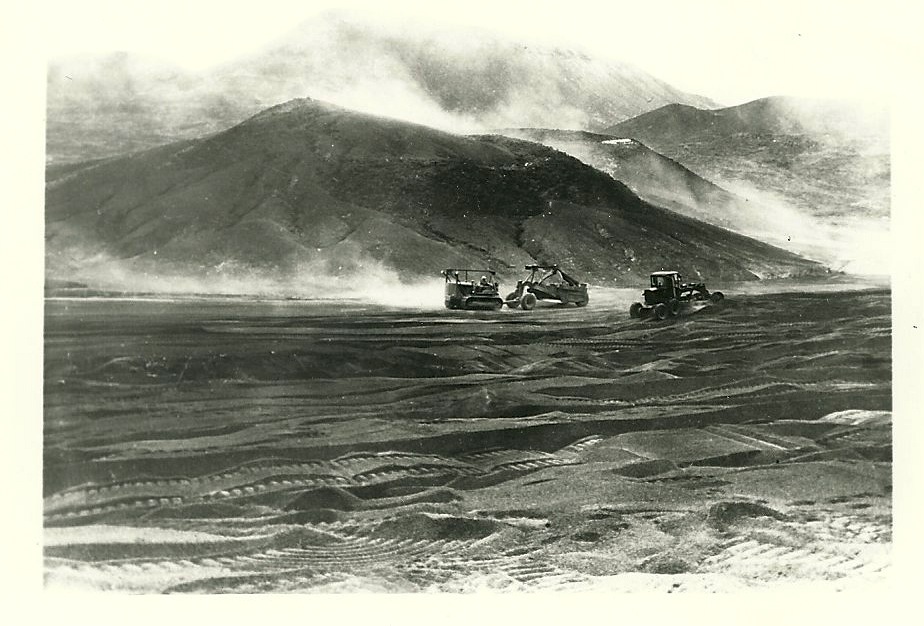
Wideawake Field, under construction in 1942. To me this looks like a big bunch of dirt, going near which would require me to shower and re-do my hair. But to my father it was engineering and as such an absolute barrel of fun.
William Ashley Chapman when he returned to Ascension Island in 1988.
"No man is an island entire of itself; every man is a piece of the continent, a part of the main; if a clod be washed away by the sea, Europe is the less, as well as if a promontory were, as well as any manner of thy friends or of thine own were; any man's death diminishes me, because I am involved in mankind. And therefore never send to know for whom the bell tolls; it tolls for thee." John Donne 1627
I have been boxing up my father's memories and his extensive correspondence and photos of his first years of World War II. I will be sending them to the Historical Society of Ascension Island, the British Overseas Territory in the South Atlantic, where they will be a part of their archives and where some of the photos will be displayed in the American Room.
Ascension Island 1942. Work on Wideawake Field was difficult as the island is solid volcanic rock, so it took repeated blasting to construct the runway.
I've written many times about my father's work with the 38th Engineer Combat Regiment on Ascension Island during the war. His two years there were austere but fascinating--islands are almost always interesting--and his work there was the part of the war he loved to remember best. First of all, this kid who had just graduated from Auburn University had his first role in management: at the age of 21, he was an officer with a company of other young men for whom he was now responsible. And then, this engineering student who had only read books about building things, got to build an airport! What fun!
It may just look like a bunch of dirt to you and me, but this airfield handled twenty-five thousand planes in World War II and is still in use today. Wideawake Field, 1942.
On Ascension, unlike Okinawa where he was near the war's end, there were no civilians behind barbed war, no American cemetery with daily services for men killed in combat, no POW camps, no daily bombings, no daily terror.
Wideawake Field on Ascension is still in use and is still an American airfield on a British Island, so it has a few USAF staffers stationed there along with a small contingent of British civilians who work at a BBC relay station. In the last few years I've been in contact with Shari, a USAF non-com on the island who, in addition to her many other duties, works to maintain the American Room at the Historical Society.
The 38th Engineers built the building behind these men. My father isn't in the photo but wrote on the back: "Command Hill building 1943. It lasted because we built it of cement-cinder blocks which we made. The tile roof came from Brazil."
The Command Hill Building on Ascension Island today.
When my father died, I couldn't bear to read all the many files he had kept about Ascension. He had gone back there at least twice (perhaps a third time too, though I'm not quite sure of that) and near the end of his life he told me many times, "I wish I could take my whole family with me back to Ascension." Oh I wish I could have gone too! When he was able to go, unfortunately, he didn't ask my sister and me to come with him, and, since transportation there had to be on a USAF plane, perhaps it was only possible for him--a retired Colonel--to take our mother with him. But it did make me sad that when it was far too late, he wished we could go with him.
As the months have gone by, the pain has grown less, and I contacted Shari again and asked her if she could use Dad's archives. She answered right away with a happy "yes" and this weekend I sorted through the box on Ascension and was able to get it ready for shipping.
This is one of the photos in Dad's files. It shows his first glimpse of Wideawake Field out of the window of the AF plane that took him back to the island after forty years. The runway is that straight line you can see across the upper right of the photo.
I've done research for three small books as well as for a history research grant I received in Florida, and that work taught me the value of the things people save and donate to libraries and archives. Letters, diaries, papers and photos all become gems to a researcher. Since I had that experience, I realized how valuable both of my parents' things might be to history archives.
William Ashley Chapman on the edge of Wideawake Field, forty years after World War II.
Not only do I want them to be remembered, I want to help historians of the future know more about the part each person played in our country's history: the war against the Axis Powers, the founding of a suburban village, the life of post-World War II families. All of these things will be details writers will thirst for a century from now.
So, I am determined to sort through the things my parents left in this house--and holy cow, they sure left a lot--and make sure the good stuff goes to their college libraries, our town archives, World War II museums, and, to Ascension Island.
Because as the poet John Donne wrote so beautifully, we are each a "piece of the continent, a part of the main." Each of our lives has meaning. We are the rich tapestry of America.
My father is the skinny kid at left with his shirt off at ROTC camp 1940. Two years later he would be at war.
My father with his fellow company commanders on Ascension Island: top row, Gaston Holliman, Harry Tufts, WAC. Bottom row: Ray Kidd (KIA, Ie Shima) and Herb Schiff.
My father, home from Ascension on leave in Homewood, Alabama, with his sister Helen.
My father's contribution to World War II was small, as was the contribution of Wideawake Field. Many soldiers and many families made much greater sacrifices. But each was a piece of the whole. And each part that can be, should be remembered.
Caps from Ascension Island Island. Since almost no one ever goes there, almost no one has one Ascension Island cap, much less a gaggle of them like this.
My father speaks about Ascension Island in a continuous loop. He was stationed there during World War II and something about his experiences on this remote, quirky volcanic island have stuck in his declining memory. He and the 38th Engineers built Wideawake Field there, where 25,000 planes ferrying men and supplies to the China, Burma, India theatre could land safely to refuel en route.
One day my Dad said to me:
"I have this hat from Ascension I got when I went back there twenty years ago. Wouldn't it be nice if somebody there sent me a few more caps like this for my grandchildren and said, 'No charge, sir. Thanks for your work?'"
I know my father doesn't remember it when he makes wishes like the one about the caps. But after he said it, I came back to my place and got on the Internet and contacted the administration of Ascension Island to see what I could do.
The island is in the British Commonwealth, though Wideawake Field is still administered by the U.S. Air Force and is a down range site for missile launches and NASA. (The tiny island is in the Commonwealth because Napoleon was exiled the second time to St. Helena, which is 700 miles away. The British didn't want him to have an island, even 700 miles away, from which he could launch another comeback.)
When I didn't get an answer to my electronic message in the first few weeks I started to gripe under my breath at the British: "Typical. They're happy to have us save their bacon, but ask them for a couple of caps and you never hear back." I shouldn't have been so hasty. And anyway, it wasn't the British administration that responded.
After about a month, I received a note from a young woman stationed on the island who works for the U.S. Air Force and who is also Chairman of the Ascension Heritage Society. On a place with a total population of 1,100, people generally wear several hats--speaking, as we were, of hats in the first place.
As we e-mailed back and forth, she asked a lot of questions about my father's service there and said she and the Heritage Society were working to learn more about the U.S. World War II sites before all of the men who were stationed on the island in 1942 had passed away. I gave her all the information I had--and heaven knows, I've heard my Dad's stories enough lately--and I gave her the name and address of the only other surviving officer I knew about.
She said she would see about the caps.
Today, they arrived in a manila envelope from Ascension, via Patrick Air Force Base in Brevard County, Florida. Since Ascension is volcanic, each one has a volcano on it with a little eruption cloud above it. And they came with a really nice note:
Dear Col. Chapman: I hope you like these hats. We, at the Ascension Heritage Society are very grateful for all that you and your men did while on the Island. We are working diligently to preserve the U.S. Army World War II sites. Very truly yours, Ms. Shari Parkhill, A.I. Heritage Society
That's twice in a week somebody has thanked my father for his service during World War II. And I won't say he was beaming, because he never really did that when he was well and he's much less able to beam now, at 89. But he was happy. And he put on one of the new caps to show it.
Beards? No shirts? After almost five years of war, the battle-hardened Americans had dispensed with many of the formalities. My father is at right on Ie Shima near Okinawa, 1945.
For my father, with his sad disease of lost and confused memory, his participation in World War II is the one constant in his conversations these days. He told me recently that he's sorry he hasn't been able to get to know my sister better but that being away at war all that time must be why he hasn't seen her since she was born. The war was over sixty four years ago, and my sister wasn't born until he returned from overseas, and he sees her frequently. But this is less and less clear in his mind.
He talks almost exclusively about the first two years of World War II, during which he served as a unit commander and aviation officer in the U.S. Army Corps of Engineers. Just a few months after Pearl Harbor, he was sent aboard a converted ocean liner to Ascension Island, where he and his men had orders to build what became Wideawake Field. It was used by 25 thousand planes ferrying supplies, troops, and munitions into the CBI theater. And, it was about the safest place a young officer could be in those first bloody years of World War II. It was isolated and exotic and quite an adventure for the kid from Birmingham and perhaps that's why he talks about it all the time today.
Consequently, I was very interested when I came across an album of photos that had apparently been kept by my mother's mother, my Grandmother Latta. It includes photos of my Dad during the second phase of the war for him, on a little island called Ie Shima, a place he served that he almost never talks about. There, on Ie Shima, he was in harm's way during the part of the war (he told me once long ago) that he didn't think he would survive.
Captain Chapman showing off the swell accommodations he had on Ie Shima.
The island is one of the Japanese islands in the Ryukyus chain, the best-known of which is Okinawa. Fighting on Okinawa in the early months of 1945 was so terrible that the Pentagon told the President he could expect at least a million casualties in the invasion of Japan, that was expected to come next. While U.S. troops mopped up on Okinawa, on April 16, 1945, U.S. Marines and the U.S. Army Infantry swept onto Ie Shima where there was an airfield that had to be neutralized and could be reused in the days ahead. The fighting was bloody there too.
The uniforms were old and worn. Captain Chapman with his men on Ie Shima. He returned from Ie with a Bronze Star. Today he doesn't remember anything about receiving this award for valor.
Dad once said Ie Shima was secure when he arrived. But I've looked at his Army records now and the history of the war and have learned that Dad arrived on Ie Shima on April 22, 1945 and that the last assault on U.S. troops on Ie took place during the night of April 22-23. While he and the Corps of Engineers were rebuilding the airstrip on Ie there were daily assaults by Japanese planes. "We just kept on working. We had to. We were on a deadline," he once said to me with a shrug. "I felt kind of sorry for those Japanese pilots. They flew over and dropped bombs on us, but every piece of artillery on the island opened up on them. They almost never got away."
My Dad's friend, Capt. Ray Kidd, was killed as the result of just such an assault. It was just two weeks before the war ended.
And there were thousands of bodies--both Japanese and American--that had to be buried in those early days on the island. Being on Ie Shima was not the fascinating, exotic, assignment that being on Ascension Island had been. Being on Ie Shima was really being in the war. Maybe your mind would want to forget it too.
The company commanders during the good years on Ascension Island. Captain Ray Kidd is at far left. 2nd Lt. Ashley Chapman is second from right.
Dad has always said that journalist Ernie Pyle was killed on Ie just one day before he landed there. The record shows that Pyle was actually killed on 18 April, four days before my Dad got there. But Pyle's death was devastating to American soldiers and they were probably still talking about it when my Dad and his unit landed. Pyle was a journalist who traveled with soldiers and wrote about their lives back home and the daily grind of their lives in wartime. In fact, his death on Ie calls to mind the closing scene of The Story of G.I. Joe, a movie based on Pyle's dispatches. As their officer lies dead after a battle, his men, one by one, file by him. One soldier takes off his helmet and says: "I sure am sorry, sir." That's the way American soldiers felt about Pyle's death on Ie.
My sister and I wonder why my father's memory record is stuck on the months he spent on Ascension Island. But, maybe that was the last period in his young life of absolute optimism, before he knew about the really bad things that can happen. Maybe that was the end of the innocence for William Ashley Chapman, the much beloved son of Roy and Mary, who made it safely home from war and still, deep inside the recesses of his brain may wonder why.
My sister Kimberly was born after my father returned from World War II. She laughs at this picture, taken in Palo Alto, California, because the cars look so old. But we always remind her that they didn't manufacture automobiles during the war so she really isn't of Model T vintage.