These devices can actually be used for transportation.
If you want to strike a blow against the oleaginous tyrants in the Middle East, without firing a shot, here is an idea: this week, and every week, do one errand on foot or on a bicycle. Using less oil, tainted by blowhards straight out of the Middle Ages--except for their Swiss bank accounts--is the best thing I can think of to help America and the world rid itself of those bad guys in the stupid hats.
Where is the leadership in America that might ask us for such a tiny sacrifice?
Winston Churchill inspired his country to take up small deeds like this to fight the Nazis as did FDR.
My Grandmother Mary Chapman and her Victory Garden in Homewood, Alabama, 1943. On the back my wry Aunt Helen has written; "I hope victory is not dependent upon our Victory Garden."
JFK had lots of inspirational ideas--from "getting this country moving again" to the Peace Corps. Have we grown so sloppy and slobby that we like being in the debt of dictators who use the jets they buy from the West to strafe and bomb their own civilians?
Walking and/or riding a bike to run an errand would strike at least a small blow for the good guys. It would also be good for the waistline. If enough of us do it, it might serve to stabilize the price of oil. It would help the GNP to have fewer dollars going out of the country and into the pockets of Emirs who like to hire Beyonce for their birthday parties.
Or would we rather just keep sending our "all volunteer army" over there to get blown up? Blood and treasure in exchange for our right to drive SUVs?
Nobody seems excited about the prospect of digging more wells in America and off its shores. Nuclear power--which may have been ready for a renaissance, because so few other options remain--just took a serious public relations and environmental hit in Japan.
In Israel they are aiming at having an all-electric automobile system within the next decade. Their desire to thwart the oil rich neighbors who want to obliterate them is obvious. But they have a tiny country--such a system would be problematic in a country the size of America.
I'm a firm believer that the brainiacs doing research in labs across the U.S. will one day come up with a substitute for the petroleum upon which we've become hooked, like heroin addicts.
But in the meantime why not join the geek protest movement and hop on a non-cool bike and pedal to the library or the bank or the store to get that quart of milk? Or go "Shank's mare" as my father's generation would say. (You can look that up.)
The lives you save might belong to America's sons and daughters--or to those striving to unleash their bonds on distant shores.
The economy you aid will be our own. The weight you lose--hey, that will just be an added bonus.
Wow! What a difference a day makes. Twenty four little hours. All the sun and the flowers. Where there used to be rain ... (with apologies to Stanley Adams, Maria Grever and Dinah Washington.)
The landscaping project next door is complete, and it came with a bonus.
After so many years of neglect, I just can't get over how nice the front yard next door is looking. The sod went in and, Bingo! it really transformed the place.
Now, Dr. K will have to get someone to mow that beautiful lawn.
When the garden work started, the front yard looked like this:
In the beginning ...
Now, to see it looking like this is a joy:
What a little sod can do ...
I'm sure people in other parts of the world must think we are a little batty. Those of us who live in small suburban houses in America, like to decorate them a bit with flowers and grass, even though it takes water and time to care for them. Each of these places is our own little piece of heaven.
So now Dr. Z has hers.
And it came with an added bonus for me.
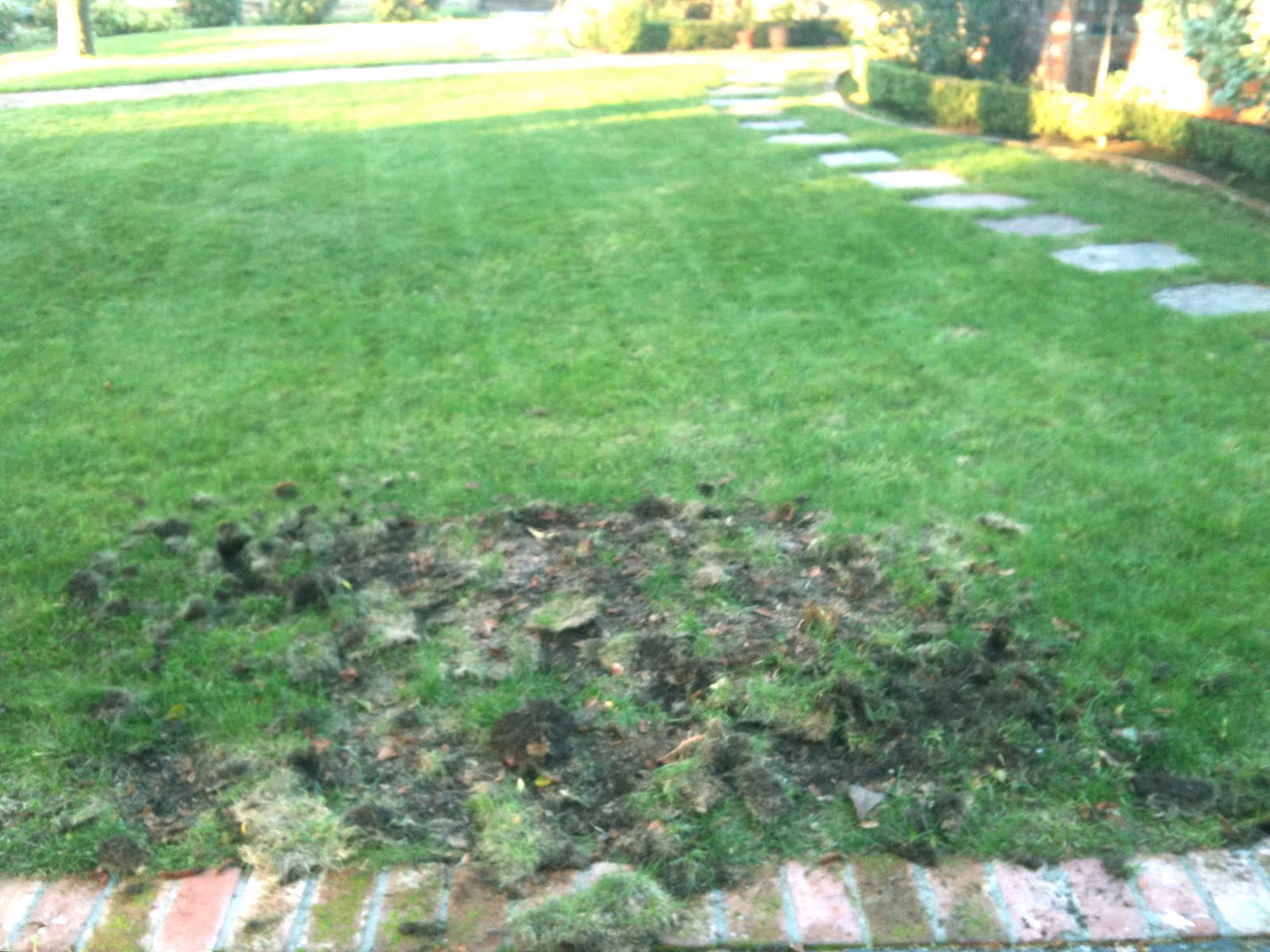
Remember the damage to my lawn made by the opossum, and the skunk and their troop of friends digging for grubs? It looked like this:
What a mess.
Mr. Potts and his workers had enough sod left over from the job at Dr. Z's that they came over yesterday afternoon and replaced the damaged sod in my lawn! Wow! Is that an improvement.
I'm going to keep it wet so it will grow and fill in the damaged spot. What a bonus for me.
So, my own little piece of heaven here in the suburbs of San Francisco has also been improved by the Good Neighbor policy of my friend Mr. Potts.
It has been quite a spring: I've just completed my t@#^&, with the help of my sister, and it wasn't nearly as painful as we thought.
In the year since I lost my father, my grief has turned from weeping to the joy one finds in the morning after a night of sorrow. I am so blessed. Because I returned to spend one last year with him, I have returned to transform what was a family home to a lovely home of my own. How hard my father worked all his life. How thankful I am now, for all his legacy means: home, neighborhood, family and friends. And for his spirit, which will always be with me here in the home he loved.
A 1920s portrait of my grandfather, Joseph Roy Chapman. He was always called Roy.
My grandfather, Roy Chapman, of Goodwater, Alabama, was the executive for Alabama Outdoor Advertising, a job he held his entire life. He was also president of the Homewood, Alabama, City Council. I never met him. He died before I was born.
But my Aunt Helen said he was a wonderful man and his death affected her in such a way that she was unable to talk about him--at least to me--for the rest of her life. In the letters I have read of his, and in the love he gave my father, I know he must have been a good and kind man.
We used to have a portrait of him, and therein hangs the tale.
A photo of Roy in the 1930s.
When Roy died, World War II had just ended, and my parents had been married only few years. They were on the other side of the continent from Alabama, in California, building and decorating their first home. My grandmother sold her home and sent my father some of the family things she thought he might want.
One thing was a baby grand piano. Another: an oil portrait of my grandfather.
My grandfather knew a lot of sign painters in his business, and during the Depression, the story goes, one of them borrowed some money from Roy Chapman that he could not find the means to repay.
So, he offered to paint a portrait of Roy, and, in further evidence of Roy's kindness, he agreed to the barter.
My mother didn't like the painting, though none of us knows exactly why. In any case, it was never given a place of honor in our home. It was in a closet for a while, and then it was in the garage.
My Aunt Helen was visiting one year and found it in the garage and told her brother that this was not a nice thing to do with a portrait of their father. She told him she would take it back home to the South with her. My mother didn't mind--obviously--and my father wanted whatever my mother wanted. Thus the portrait vanished from our lives.
After the death of my father's sister--my Aunt Helen--I knew my cousin had the portrait. And, with my interest both in family and art, I called her last year and asked if she was interested in our grandmother's baby grand piano. She was. If I sent her the baby grand piano, I asked, would she send me the old portrait of Roy Chapman? No, thank you, she said. Roy was very happy where he was. But she volunteered to have it copied--which was a nice thing to offer, though it was not what I wanted.
Well, I tried! We had lots of nice photos of Roy in any case.
My grandfather in his World War I uniform.
Yesterday, my sister and her husband were rummaging through the boxes in the space above the garage, and my sister came in and said there was a box labeled "Dad's portrait." It must be mislabeled, I said, as that portrait is no longer on this coast.
But, in a way, I was wrong.
A few minutes later, in came the portrait of Roy Chapman as a young man.
My Aunt Helen was as thoughtful as her father and, though she had taken the original, and knew my mother didn't like the painting, with an eye to the future, she had made a copy of it for her brother. The copy was hidden away, as had been the original: but Aunt Helen may have thought that one of us would eventually come across it, as we did, and it would re-emerge into the daylight.
I always liked my Aunt Helen.
The copy isn't as much fun as having the real thing: but it does appear that the original was indeed a good painting--as I had long suspected. The shadows on Roy face and the other details are wonderful, and it has the American primitive style of a self-taught itinerate sign painter that now marks the era.
I like it very much, even though it is a copy: for the funny story behind it and for the charm of the portrait itself. I can see my father in that face and something of my cousin in it too.
And I love the 1920s collar he is wearing.
I now have another reminder of family in this beautiful home my father left me. Roy's portrait took a long and circuitous route to get to this place, but that isn't unusual. We all do that, in life, to get where we are going. And we never know where that is going to be.
Mr. Potts and his assistant, Mr. Toby Tyler, working next door.
The transformation continues at the house next door to me. It is Dr. Z's new home, and it has been long neglected, so it is good to see the changes.
Saturday morning, before he went off to play golf, Mr. Potts set out the plants he was going to place around the garden, for installation today.
He saved the bird of paradise plant that had been up against the house, and divided it so it could be used in more than one place, and he added other plants that will do well in our dry California summer: a California orange tree, some New Zealand flax (very popular now as it needs little water), a barberry plant and some nandina.
There is also juniper, dusty miller, statice flower, sage, and several azaleas. I don't know when the lawn goes in, but it looks as if it will very soon.
Mr. Potts is a rare landscaper among those I've met: he knows a lot about plants and has a love for them. This is a secret I am now sharing with you because Mr. Potts is a big jokester and makes a joke of everything so you won't know how much he loves his job. He even makes a joke of the fact that I wear striped socks--he says they make me look like the witch in the Wizard of Oz. Especially when I ride my bike with the basket in the front.
But, because he works with that friendly fellow, Toby Tyler; and because his wife Donna is a good person and was kind to my mother and father; and not the least because he is doing such a good job at the house next door: I forgive him his jests, especially now that I have learned his secret love of plants. He's a good neighbor, and that's a good thing to have.
The house next door has had a chequered history. While one family lived in our house for five decades, half-a-dozen owners lived next door. The retired German couple, the eccentric heiress, the podiatrist who always had a cocktail in his hand, the Zen Buddhist married to the ex-G.I., and the Chinese restaurant owner and his clan are a few who come to mind.
Long ago, it had a beautiful formal garden in the back with roses and camellias and a gravel path raked carefully by a Japanese gardener. Now the back is just an open field--I don't really mind it that way, as it makes me feel as if I live next to an open space preserve.
The front, however, is a different matter. But that is changing.
Front view of the house next door.
The new owner is a physician from Iran who works at our local hospital. She decided something should be done about her front yard, and turned to another neighbor for help.
Work begins.
Our neighbor, Mr. Potts, has a landscaping business and this week he has been transforming Dr. Z's front yard, with the help of his friend Toby, the errant yellow Labrador.
Mr. Potts' assistant, Toby Tyler.
California is very water conscious, green conscious, global warming conscious, non-invasive species conscious, and pesticide conscious, so this will be a very conscious garden. Much more environmentally correct, it will also look a heck of a lot better than it has been looking.
Neighbor helping neighbor.
This is also a very good lesson in micro-economics. Dr. Z gets a job and hires Mr. P to landscape her yard. Mr. P. has work for two employees (plus Toby). All (except Toby) pay a portion of their income in taxes and use the rest to save ($ which can then be borrowed by other people to build and expand) or buy things that keep other people working. All this without the help of any government stimulus whatsoever. Amazing.
Under this new economic plan, even a greenhouse, somewhere, benefits. As does our neighborhood.
I've been taking photos of the transformation, and it promises to be a thing of beauty. I get to see more of Toby too, because he likes to escape from time to time and visit me. Throwing a stick for him is always a nice break from working on my t@#$s, and cleaning my house for the upcoming visit of my sister and brother-in-law.
Stay tuned and I'll have more pictures as the work continues. It is a good sign that houses are selling and people are doing things like landscaping. As California goes, so goes the nation. At least that is what they say.
I don't want you to think I am feeling sorry for myself, as I am not. But March comes in with a little sadness this year, since it was on March 26th of last year that I lost my Dad.
I say lost him, but that isn't really accurate. He's always with me--but I lost him here on the semi-solid ground we called earth.
In my life, I always felt he was the one person I could rely on--if the worst came to the worst, which it does from time to time--and I always could. So last March, as I knew I was losing him, was difficult. And it is tough now in retrospect, as March is also my birthday month, a month I have always enjoyed for its daffodils and blossoms.
March in my California garden.
I have thought a lot about heaven in this past year and I have asked lots of people what they think it is like. I figured my Uncle Joe, a devout Catholic, would be a great source on this. But when I asked him what he thought it was like he shrugged and said, "I have no idea." He is a very practical man.
We have a relative, now gone, who was a Dutch Reformed pastor and he told my cousin Karen; "I don't want to go to the heaven with the harps. I want the one with the trumpets."
A Lutheran minister I have known practically all of my life said: "I think it will be very exciting. Do you know they have discovered five new planets out there?" He is a brilliant man who was always a great friend to my father and I realized that his idea of heaven would be the excitement of eternally having new things to learn, and new worlds to explore.
As humans, it seems to me, we are in a dark room, feeling around for what eternity must be like, and, grabbing the elephant's tail, we make the whole into something we would like it to be. And yet we know it not. So, for now, I'm going with my friend Pastor H's version of heaven--with Dad zooming out into the universe and going so fast he actually gets younger as he goes, ending up on one of those five new planets, a young man again. There will be lots of new flying machines there for him to play with and learn about and plenty of time to fly them. And, he can spend all the time he wants reading his Physics textbook.
So, I know I shouldn't be sad this March. Because he's okay. But I am missing him, as he has gone on such a long trip, and I have had to stay behind.
On March 26, in his honor, I'm going to bring the flag down to half staff at Fort Chapman, just for the day. I was privileged to share part of my father's journey with him and to have learned so much in the process. If you don't understand about death, you don't understand much about life.
And near the end of his life, my father grew more joyful. And I am remembering that as March comes in--more like a lamb this year, than usual.
Dad, sailing a toy glider at our local school, on another spring day, when he was about eighty-five.