Showing posts with label San Francisco Bay Area. Show all posts

Monday, August 20, 2018

Juana de la Briones: A Self-Invented California Pioneer

Most of the land owned by Juana Briones--more than 4,000 acres--became the town of Los Altos Hills. But the house she built about 1845 ended up in the city limits of Palo Alto. It was finally razed in 2011. Photo courtesy of the Palo Alto Historical Association Archives.

I've recently written a new book called Historic Bay Area Visionaries, which includes the stories of six people from California history I know you will want to meet. They include an Ohlone Indian named Lope Inigo, California pioneer Juana Briones, poet Robert Louis Stevenson, heiress Sarah Winchester, immigrant millionaire Thomas Foon Chew, and silent film star Charlie Chaplin.

Wednesday, October 25, 2017

California's Juana Briones and the Mystery of a Photograph

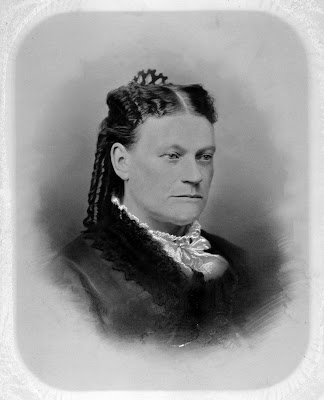
Descendants of Santa Clara Valley pioneer Juana Briones believe this photograph to be Juana.
Only available through the Point Reyes National Seashore Archive, it may not be used without their permission.

I am working on research for a new book about some exceptional people in California. There have been so many who have lived and worked in the region of the San Francisco Bay Area, long before Silicon Valley. While researching this group, I've uncovered lots of interesting stories.

One of them, Juana Briones, had family who came with the first Spanish-speaking civilians to settle in the San Francisco Bay Area. Juana's mother came to California as a four year old, with Juan Bautista de Anza, settling with her parents in the first pueblo of California, the pueblo of San Jose.

Wednesday, March 4, 2009

"Artistic Luxury" at S.F. Museum

A necklace of green glass frogs and jewels by early twentieth century designer René Lalique.

The artistic opulence of turn-of-the-twentieth century luxury is celebrated in a new exhibit at the Legion of Honor in San Francisco, and if you love beautiful things it is the show for you. The exhibit is titled: Artistic Luxury: Fabergé, Tiffany, Lalique and runs through May 31 in the City By the Bay.

The museum offers free admission on the first Tuesday of each month, so I chose a Tuesday to head up to San Francisco from my home on the peninsula just 46 miles away. San Francisco is almost always colder, foggier and windier than the Santa Clara Valley so, since it was pouring sheets of rain in Los Altos, I expected the worst in the City. Well, anyway, I told myself. The museum is, after all, indoors.

But as I cruised along the most beautiful highway in the U.S., Interstate 280, up against the foothills of the Coast Range, the sheets of rain let up at about San Mateo and it was clear sailing into San Francisco. The Legion of Honor museum is located in a corner of the City where I haven't often traveled. It is just on the edge of the old Presidio, on a hill overlooking the Bay. You have to be careful or you'll end up going over Golden Gate Bridge if you miss your turn. New-old-comer that I am I almost did just that, but at the last minute took the last exit and found myself at Fort Point, just about where Kim Novak was rescued by Jimmy Stewart when she jumped into the Bay in Vertigo. Like a good tourist I got out and took a picture, and you just can't take a bad picture from that location.

There it was, posing for me at the edge of the Presidio.

From there, all I had to do was wind my way through the Presidio to the edge of Lincoln Park and that wasn't difficult. I parked at the foot of the hill and walked the quarter mile up to the museum. It was good exercise after sitting in the car for fifty minutes and when you get to the top the view is worth the walk.

Even on a grey day the Legion of Honor was blooming with color.

There were so many beautiful objects in the show--jewelry, hair combs, vases, lamps, brooches, stomachers (that's a bibelot dripping in diamonds you wear over the front of your dress), Fabergé eggs, and Tiffany lamps, it was almost more than you could take in. Many of the Fabergé items, all covered in gems and gold from cigarette cases to eggs to jewelry to tea sets, had been designed for the ill-fated Romanaov family, the last of the Tsars. Looking at all that luxury and knowing how it was bought while their subjects suffered in poverty was a little sad. Many of the items were confiscated by the Soviets after they executed Tsar Nicolas, Tsarina Alexandria (the granddaughter of Queen Victoria) and their entire family. But they certainly enjoyed their exquisite jewels while they reigned.

Fabergé necklace of Siberian amethysts.

The Tiffany and Lalique objects had a somewhat more cheerful history, purchased in the West for the wealthy sons and daughters of successful capitalists, God-bless-'em, in Europe and America.

I was familiar with the designs of Louis Comfort Tiffany because Winter Park, Florida where I lived for twenty years, is home to the Charles Hosmer Morse Museum of American Art with the largest collection of Tiffany objects in the world. The Morse recently re-designed its jewelry exhibit and as my friend and museum executive Catherine Hinman told me, "We don't have anything in there that we would loan." So, if you enjoy the San Francisco show you have another treat on your hands the next time you visit Central Florida. (See more on their web site at http://www.morsemuseum.org/).

A Louis Comfort Tiffany brooch in the San Franciso exhibit.

But the Getty family loaned the Legion of Honor show several important Tiffany lamps and Queen Elizabeth II and Prince Albert of Monaco also sent over a few priceless knickknacks from their own collections. And, oh yes, Joan and Melissa Rivers sent over a few things. But they didn't say which ones, so one could only speculate.

At right: one of Fabergé's rare be-jeweled Easter eggs.This one was given by Tsar Nicholas II to the Tsarina in 1907.

Since it was free day the show was very crowded, especially crowded with French-speaking people who didn't budge so others could see around them. I stayed as long as my brain would allow me to download all this beauty and then I walked to the coat check for my umbrella (not allowed inside the show.) Adjacent to the coat check was a little cabinet with beautiful jewelry from Greece and Rome, circa 200-500 BC. Each of the pieces could easily compare with the lovely jewels of the Belle Epoch exhibit down the hall. Just goes to show you--people have been enjoying beautiful things since the dawn of time.

Outside, the rain had started again, and the mist made the city look like the land of Sam Spade and the Maltese Falcon. I stopped to take a picture of the Bay, with Alcatraz cold and lonely in the distance.


And then I did what any good tourist would do: I headed over to Fisherman's Wharf to buy a couple of Dungeness crabs and some sourdough bread for dinner. The sun came out again and the sad fate of the Romanovs faded from my mind. The real jewel of this adventure had been San Francisco herself.

They were awfully good, and since they are only found on the West coast, I at least know they were caught somewhere not farther away than say, Alaska.

Is it the prettiest bridge in the world? It certainly can be found on a lot of charm bracelets.

All of the photos of the "Artistic Luxury" exhibit are the property of the Cleveland Museum of Art in conjunction with the Legion of Honor in San Francisco and Yale University Press. They are used here under the Fair Use provisions of the law, in this news article only, and should not be reproduced for commercial use.

Subscribe to Robin Chapman News


Sunday, January 4, 2009

Circling Back Towards Home

This vintage postcard is a great help in visualizing the topography and geography of the San Francisco Bay Area. At center left is the city of San Francisco (aka "The City" to locals). Look south from San Francisco and you can see San Mateo, Belmont, Palo Alto and Mountain View. My hometown of Los Altos lies between Palo Alto, home of Stanford University, and Mountain View, home of Google. Between the Pacific and the Bay you can see the mountains of the Coast Range, sheltering the Santa Clara Valley from the wind and cool of the Pacific Ocean. San Francisco, near the mouth of the Bay, can be very cold in the summer, but down the sunny peninsula where I grew up and to which I return, it is always mild and pleasant. Well, nearly always.


Los Altos, California The fog and clouds rolled back out into the Pacific, leaving my hometown in California’s Santa Clara Valley, at the edge of San Francisco Bay, sunny, clear and cold. The thermometer didn’t rise above 48 degrees (F) yesterday and the low last night was 27 degrees. That's a might nippy for someone who has spent the last twenty years in Florida.

But I keep looking up Echo Drive—my hometown street—at the foothills of the Coast Range. These are the hills between the San Francisco peninsula and the Pacific Ocean. Nothing unusual about them, except that they look so beautiful to me after the flat, sandy topography of Florida.

My father has been mostly fun to be with on this visit, though he is often very confused. I think any break in the routine of a dementia patient is cause for confusion. When my sister is here and I am not, my father can’t figure out why we are not here together and forgets my name. When I’m here and my sister is not, the same thing happens. He has asked me my sister’s name several times this week, her age, where she lives, what she looks like, what she is doing with herself, and most surprisingly, who her mother is!

I know he knows these things, but I patiently answer each time. I show him pictures of her and of the two of them together just a few weeks ago, and he is temporarily satisfied. Until he starts asking me again a few hours later. In between, I take him for ice cream and for pancakes, his two favorite things to eat in the world, and that makes him happy. It is always rewarding to be with him, except when he is agitated, and that hasn’t happened so far on this visit. When he woke up this morning and saw me walking into breakfast he said, “Oh Robin, I’m so happy to see you. Please don’t ever leave me.” Do you wonder I decided to move back here—in spite of everything?

I’ve been working hard at avoiding conflict with my mother. Everyone in our family has done that all of our lives, so it isn’t a new task. I realized it so clearly one day when I was reading playwright Moss Hart’s wonderful autobiography, Act One. In it he wrote about his own mother and said he believed each family tends to revolve around its most dysfunctional member. I hadn’t thought about it before, but it is one of those statements that is so true, it seems to open up the heavens for a moment and gives you what I believe is known as an epiphany. Voila, as the French say. Eureka—as we say in California (it’s the California state motto).

In order to help me, I’ve been reading Christine Ann Lawson’s book, Understanding the Borderline Mother and it has been especially helpful. I’ve been trying to follow her advice: a) don’t enable her but don’t try to control her—let your mother control herself and you control yourself; b) avoid getting drawn into discussions of controversial subjects, since these discussions will go nowhere that is positive; c) do no harm; d) disengage and leave the scene when you see the onset of troubling or abusive behavior.

This is all very good advice. The difficulty comes when someone as close to you as your mother presses old and wounded buttons: bad habits click in. I am not worthy, you say to yourself, and you are a child again. As Lawson puts it: “Degradation by someone who claims to love you is qualitatively different than degradation by a stranger.” Keep a safe emotional and physical distance from a person with Borderline Personality Disorder, she tells her readers. Hard to do for a houseguest, but I’m hoping it won’t be quite so hard when I am living a bike ride away.

And I’ve found a lovely place to live (with a fireplace that I could make good use of at this very moment) in a neighborhood less than a mile from my parents’ house. I’ve always liked this neighborhood: it is one of the older parts of town and is filled with small, sunny, adobe cottages and now, some duplexes and condominiums. On warm summer days when I was a child, I used to cut through this neighborhood on my way to the library, walking streets named Gabilan and Tyndall and Lassen, imagining myself living in a little bungalow there. Odd, isn’t it, how the circle goes ‘round?

Perhaps the mountains of the Coast Range, visible out my window today, are a symbol of the mountains I have to climb as I face this challenging time in my own and my parents’ lives. Children helping parents who don’t want to need you. Families are challenging enough and mine seems more challenging than most. Then, uprooting and moving across America: no easy task. But perhaps the mountains that so intrigue me now are also a symbol of the opportunities ahead—opportunities to reach the places I used to dream about so long ago in childhood on those warm summer days.

Subscribe to Robin Chapman News